

Sulfur hexafluoride (SF6) has been the standard insulating and arc-quenching medium in medium voltage switchgear for more than four decades. That era is now closing. Regulation (EU) 2024/573 prohibits SF6 in new medium voltage equipment up to 24 kV from 1 January 2026, and California has already begun its own phase-out. For utilities, EPC contractors, and industrial operators specifying equipment today, the practical question has shifted from whether to adopt SF6-free technology to which SF6-free architecture fits the application. This guide covers the regulatory timeline, the three mainstream replacement technologies, and the engineering criteria that should drive your specification.
The Regulatory Timeline for SF6 Phase-Out
Regulation (EU) 2024/573 entered into force in March 2024 and sets binding dates for placing new F-gas-insulated switchgear into operation. Existing SF6 equipment may remain in service, but all new procurement falls under the schedule below.
| Voltage / rating class | SF6 prohibited in new equipment from |
| Medium voltage, up to and including 24 kV | 1 January 2026 |
| Medium voltage, above 24 kV up to 52 kV | 1 January 2030 |
| High voltage, 52 kV to 145 kV (up to 50 kA) | 1 January 2028 |
| High voltage, above 145 kV or above 50 kA | 1 January 2032 |
Two details matter for buyers. First, the derogation mechanism only applies where a tender receives no bids for fluorine-free equipment; with SF6-free designs now commercially available at 12 kV and 24 kV from multiple manufacturers, exemptions at these ratings are effectively closed. Second, from 1 January 2035 only reclaimed or recycled SF6 may be used to service existing installations, which will raise lifetime maintenance costs for legacy fleets.
Outside the EU, California's CARB regulation began phasing out SF6 in gas-insulated equipment in 2025, and New York adopted a similar schedule with first medium voltage dates from 2027. Projects with multi-year lead times should therefore specify SF6-free equipment now, even where local law does not yet require it.
Why SF6 Is Being Regulated
SF6 is the most potent greenhouse gas in industrial use. Its global warming potential is approximately 24,300 times that of CO2 over a 100-year horizon, and it persists in the atmosphere for roughly 3,200 years. The power sector accounts for around 80 percent of global SF6 consumption, concentrated in gas-insulated switchgear and circuit breakers.
Regulation aside, SF6 imposes operational obligations that carry real cost: sealed-pressure systems require density monitoring, periodic leak checks apply above low CO2-equivalent thresholds, gas handling demands certified personnel and recovery equipment, and end-of-life gas must be reclaimed rather than vented. Removing the gas removes the entire compliance chain.
Mainstream SF6-Free Technologies at Medium Voltage
Vacuum Interruption with Dry Air Insulation
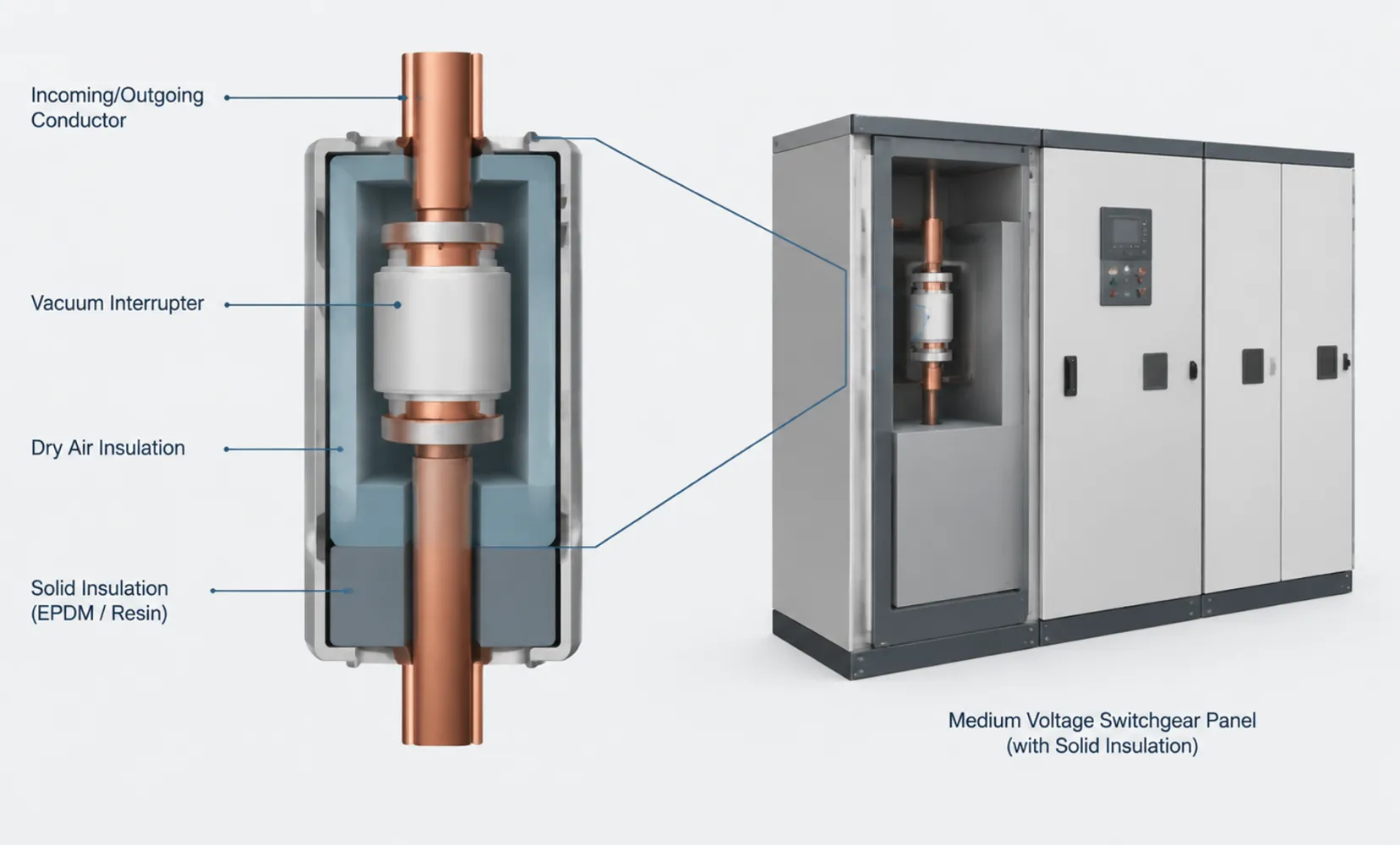
This is the dominant architecture for new medium voltage designs. The vacuum interrupter, proven in distribution networks since the 1970s, handles arc extinction with a mechanical and electrical life far exceeding any gas-based interrupter. Insulation is provided by dry air or technical air, a nitrogen-oxygen mixture with zero global warming potential and zero ozone depletion potential, held at a modest overpressure inside a sealed stainless-steel tank.
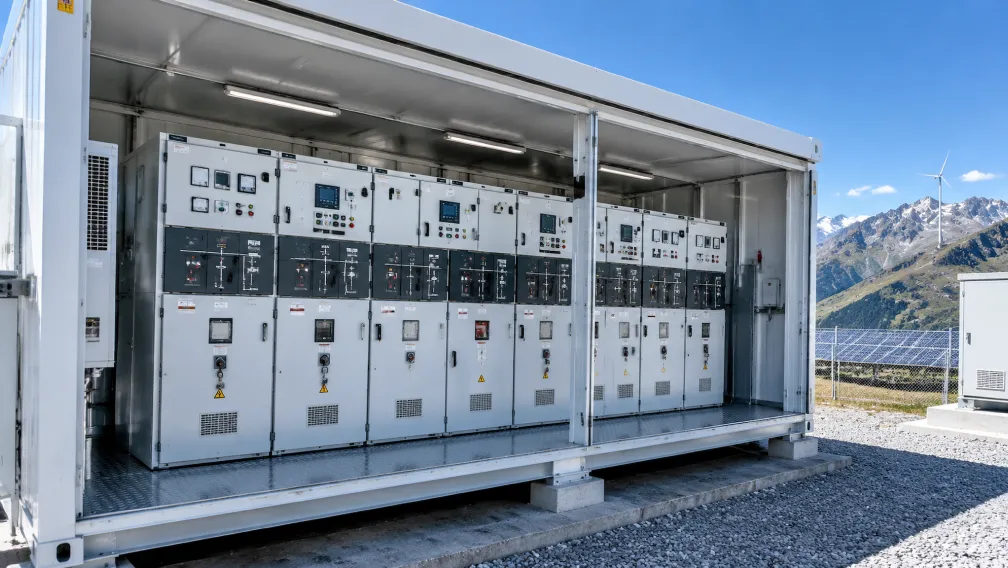
The engineering trade-off is dielectric strength. Dry air insulates roughly one-third as effectively as SF6 at equal pressure, so designers compensate through slightly higher filling pressures, optimized field grading, and solid-insulated busbar interfaces. At 12 kV and 24 kV, modern designs match the footprint and ratings of conventional SF6 panels. Our 12 kV SF6-free gas-insulated medium voltage switchgear and 24 kV gas-insulated switchgear follow this vacuum-plus-dry-air approach, retaining the compact dimensions and sealed-for-life construction that made gas-insulated switchgear the standard for space-constrained substations.
Solid-Insulated Switchgear
Solid insulation eliminates gas entirely. The vacuum interrupter and primary conductors are embedded in cast epoxy resin, leaving no insulating medium to monitor, top up, or recover. The encapsulated construction is inherently resistant to humidity, dust, salt fog, and condensation, which makes it a strong choice for coastal sites, mining, and other harsh environments. Surface discharge tracking is managed through shielded joint design and controlled interface pressures. A typical implementation is our 12 kV solid-insulated medium voltage switchgear.
Fluorinated Gas Mixtures (C4-FN and C5-FK)
Fluoronitrile and fluoroketone mixtures dilute a synthetic additive in CO2 or dry air, cutting GWP by roughly 98 percent versus SF6 while keeping GIS dimensions close to legacy designs. They remain relevant at high voltage, where natural-origin gases cannot yet match SF6 clearances. At medium voltage, however, buyers should weigh two risks. These mixtures are still fluorinated gases and therefore fall outside the EU 2024/573 medium voltage permissions. In addition, 3M completed its exit from PFAS-related production at the end of 2025, removing the primary source of the fluoronitrile used in such mixtures, and the pending EU-wide PFAS restriction adds further supply uncertainty. For new medium voltage installations, natural-origin insulation avoids both exposures.
Technology Comparison at 12 to 24 kV
| Attribute | Vacuum + dry air | Solid insulated | C4-FN / C5-FK mixture | SF6 (reference) |
| Insulating medium | Natural-origin gas | Cast epoxy, no gas | Synthetic fluorinated mixture | SF6 |
| GWP of insulating medium | 0 | 0 | Low, but above zero | ~24,300 |
| EU 2024/573 compliant (MV) | Yes | Yes | No | No |
| Footprint vs legacy SF6 | Equal at 12-24 kV | Comparable | Equal | Baseline |
| Gas handling equipment | None beyond pressure gauge | None | Mixture-specific tools and analysers | Carts, recovery, leak detection |
| End-of-life obligations | None | None | Gas recovery required | Certified recovery and reporting |
Specification Criteria for SF6-Free Procurement
Replacing the insulating medium does not change the fundamentals of switchgear specification. Rated voltage, normal current, and short-time withstand current remain governed by IEC 62271-1, and metal-enclosed designs must still demonstrate compliance with IEC 62271-200, including internal arc classification. For personnel safety in indoor substations, specify IAC classification AFLR with the tested arc duration stated on the nameplate, as in our 12 kV arc-resistant metal-clad switchgear range.
The SF6-free layer adds four checks to the tender schedule:
- Insulating medium declaration. Require the manufacturer to state the exact gas composition or confirm gas-free solid insulation, and to confirm the design contains no fluorinated greenhouse gases.
- Type test evidence. Request dielectric, temperature-rise, and short-circuit test reports issued on the SF6-free variant, not inherited from a legacy SF6 platform.
- Footprint and interface compatibility. For retrofit projects, verify panel width, cable termination height, and busbar interface against the existing switchgear room.
- Monitoring concept. Dry air systems typically use simple pressure indication rather than density relays with locking thresholds; confirm the alarm philosophy matches your SCADA and maintenance regime.
For most 12 kV and 24 kV distribution applications, the recommended SF6-free specification is a vacuum circuit breaker combined with dry air insulation in a sealed stainless-steel enclosure. This combination delivers zero-GWP insulation, maintenance-free interruption over a 30-year service life, full compliance with EU Regulation 2024/573 and the California CARB phase-out, and footprints identical to the SF6 panels they replace. Ring main unit applications follow the same logic; SF6-free ring main units using vacuum load break switching and dry air insulation are now the default choice for European secondary distribution tenders.
Total Cost of Ownership
SF6-free switchgear typically carries an upfront premium of 5 to 15 percent over conventional equipment. Whole-life costing usually reverses that gap. An SF6-free installation incurs no gas procurement, no gas carts or recovery units, no leak-check regime, no annual emission reporting, and no certified end-of-life recovery. The 2035 restriction on virgin SF6 for servicing will further increase maintenance cost for gas-insulated fleets, while SF6 market prices continue to rise under tightening supply. For assets with 30-to-40-year design lives, procurement decisions made in 2026 should be priced against the regulatory conditions of 2056, not 2026.
Performance at High Altitude and in Harsh Climates
One technical advantage of sealed SF6-free designs deserves emphasis. Air-insulated equipment loses dielectric strength as altitude rises and air density falls, which forces clearance derating above 1,000 meters under IEC 62271-1. Hermetically sealed gas-insulated and solid-insulated panels are unaffected by ambient air density, so they hold full rated insulation performance at elevations of 3,000 meters and beyond without derating. For mining operations in the Andes, hydropower plants in mountainous terrain, or renewable projects on plateaus, a sealed SF6-free medium voltage switchgear lineup removes a significant design constraint. Sealed construction equally excludes humidity, dust, and conductive pollution, reducing routine maintenance to external visual inspection.
Conclusion
The SF6 transition at medium voltage is a settled regulatory fact with fixed dates, and the replacement technologies are mature. Vacuum interruption combined with dry air or solid insulation now matches SF6 equipment on ratings, footprint, and reliability at 12 kV and 24 kV, while eliminating gas-related compliance costs across the asset life. Early adopters also remove tender risk in jurisdictions where phase-out rules are tightening year by year.
Elecstellar designs and manufactures a complete range of medium voltage switchgear, including SF6-free gas-insulated, solid-insulated, and vacuum switchgear platforms type-tested to IEC 62271. To review technical datasheets or discuss an SF6-free specification for your project, contact our engineering team.
-

STELLAR
Switchgear & Power Transformer ManufacturerSTELLAR designs and manufactures switchgear, transformers, and complete power distribution equipment from our China facility, serving utilities, contractors, and distributors in 50+ countries. Every technical article on this site is reviewed by our in-house engineers to ensure accuracy against IEC standards and real project practice.