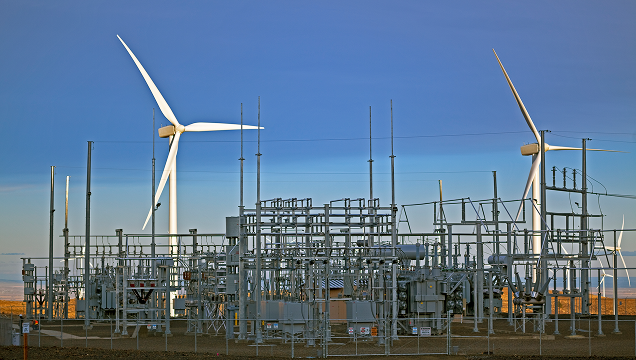


Every solar farm, wind farm, and battery storage plant needs a substation to gather its power, change the voltage, and connect it safely to the grid. Renewable generation is produced at low or medium voltage and often on remote or fast-moving sites, so the substation has to step the voltage up, switch and protect the feeders, and ideally arrive ready to install. STELLAR supplies the core of that substation, the medium voltage switchgear, the step-up and distribution transformers, and the packaged compact substations, built for solar, wind, and storage projects.
Substations for Renewable Energy
A renewable energy substation does the same job as any distribution substation, but the flow runs the other way: instead of taking grid power and stepping it down, it collects the power a plant generates, steps it up, and feeds it into the network. The substation has to handle a variable source, meet the grid code for voltage and reactive power, and often sit in a field, a desert, or an offshore location far from a built substation. Compact, factory-built equipment is what makes that practical.
Solar PV Substations
In a solar plant, the inverters turn the panels' DC into AC at low or medium voltage. An inverter step-up unit raises that to the collection voltage, and a collector substation gathers the feeders and steps the voltage up again for the grid. The medium voltage side uses medium voltage switchgear or a ring main unit to switch and protect each string of inverters, with a step-up transformer on each block. On tight or rooftop solar sites, gas insulated switchgear keeps the substation small.
Wind Farm Substations
A wind farm works the same way at the collection level. Each turbine has its own step-up transformer at the base of the tower, raising the generator output to the medium voltage collector grid that links the turbines together. That collector grid runs to a collector substation, where switchgear gathers the feeders and a transformer steps the voltage up for the grid connection. Ring main units are a common choice on the collector rings because they are compact, sealed, and let a faulted cable section be isolated without dropping the rest of the string, which matters on a wind site spread over a wide area.
Battery Energy Storage (BESS) Substations
A battery energy storage plant connects to the grid through a substation in much the same way, with the added job of running power in both directions, charging from the grid and discharging back to it. A BESS block pairs its inverter with a step-up transformer, often around 10 kV to 0.4 kV, and the medium voltage switchgear ties the blocks to the grid connection point with metering and protection. Because storage is often added beside an existing solar or wind plant, a self-contained compact substation is a fast way to bring a new block online.
The Equipment in a Renewable Substation
Whatever the source, a renewable substation is built from the same core equipment:
- Medium voltage switchgear or ring main units to switch and protect the collection feeders.
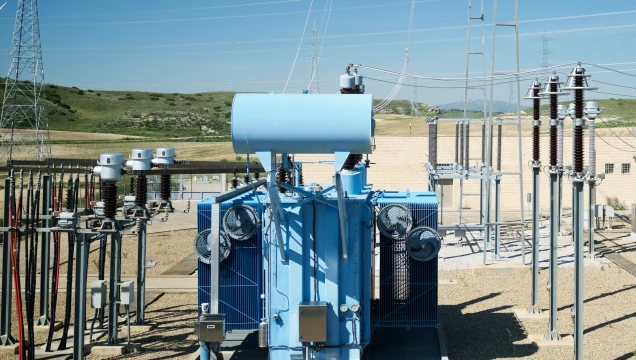
- Step-up and distribution transformers, oil-immersed for outdoor and higher ratings, or dry-type where fire safety or an enclosed e-house calls for it.
- Low voltage switchgear for auxiliary supplies and the plant's own loads.
- Protection, metering, and reactive-power control to meet the grid code.
On remote and lightly loaded sites, an amorphous core transformer is worth considering, since its low standing loss saves energy through the long hours a renewable plant runs below full output.
Why Modular and Compact Suits Renewables
Renewable projects are built fast, often in places with little infrastructure, and sometimes moved or expanded later. A packaged compact substation answers all three: the switchgear, transformer, and low voltage panel are assembled and type-tested in the factory, then shipped as one unit that drops onto a pad and wires up quickly. That cuts site work and commissioning time, which is exactly what a tight renewable construction schedule needs, and a compact unit can be relocated if the plant layout changes.
STELLAR's Renewable Substation Solution
STELLAR builds the medium voltage collection switchgear, the step-up and distribution transformers, and the packaged compact substations for solar, wind, and storage plants, all to IEC standards and configured from your single-line diagram and grid-connection requirements. Because the switchgear and the transformers come from one base, they arrive coordinated and tested together, ready to integrate with the inverters, turbines, or battery blocks on site. Tell us the plant size, the collection and grid voltages, and the site conditions, and we will configure the substation equipment to match.
-

STELLAR
Switchgear & Power Transformer ManufacturerSTELLAR designs and manufactures switchgear, transformers, and complete power distribution equipment from our China facility, serving utilities, contractors, and distributors in 50+ countries. Every technical article on this site is reviewed by our in-house engineers to ensure accuracy against IEC standards and real project practice.