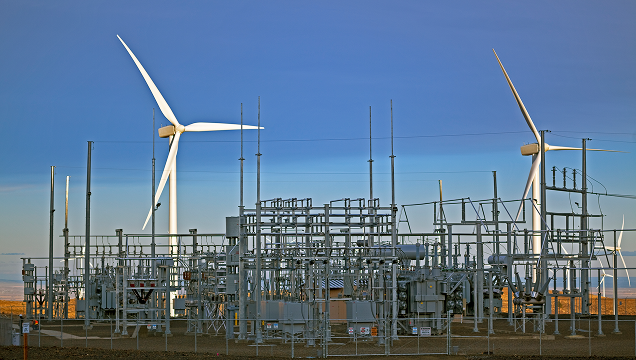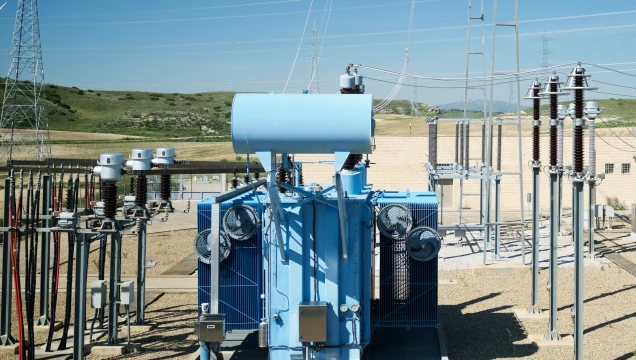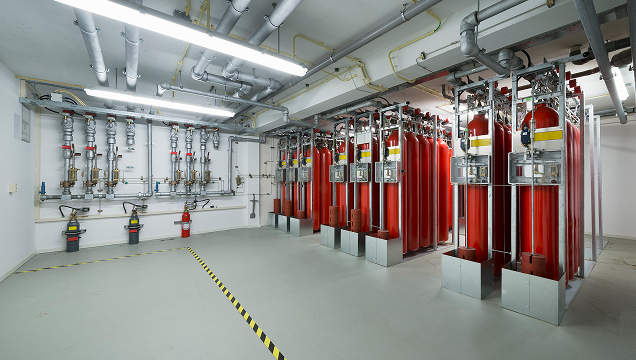


A gas insulated substation, or GIS substation, is a substation in which the live high-voltage equipment, the circuit breakers, disconnectors, busbars, and instrument transformers, is sealed inside metal housings filled with SF6 gas instead of sitting in open air. Sealing the equipment in gas lets the same substation fit in a small fraction of the land an air-insulated substation needs, which is why GIS is the standard answer where space is tight, the environment is hostile, or the supply has to be highly reliable.
What Is a Gas Insulated Substation?
In a conventional air-insulated substation (AIS), the busbars and switching equipment stand in the open, and air provides the insulation between live parts, so the equipment needs large clearances and a lot of land. A gas insulated substation replaces that open-air layout with sealed enclosures: each circuit breaker, disconnector, earthing switch, busbar, and current or voltage transformer sits inside a grounded metal tank filled with SF6. Because SF6 has roughly three times the dielectric strength of air, the same voltage class fits in a far smaller volume, and the sealed tanks keep dust, damp, and pollution away from the live parts. The core building block is gas insulated switchgear, arranged into the bays that make up the substation.
GIS Substation vs AIS Substation
Air-insulated substations still make up the majority of substations worldwide, and they remain the economical choice where land is cheap and the site is clean. A gas insulated substation costs more to buy and needs more skilled site work, but it wins decisively on space and on performance in difficult environments. The table sets out the trade-off.
| Factor | GIS substation | AIS substation |
| Insulation | SF6 gas in sealed housings | Open air with clearances |
| Footprint | Up to 70% less land | Largest; needs wide clearances |
| Environment | Sealed against pollution, salt, ice, damp | Exposed; sensitive to pollution |
| Reliability | High; sealed parts, low maintenance | Good; exposed to weather |
| Initial cost | Higher | Lower |
| Maintenance and expansion | Low maintenance; gas work for changes | Easy to maintain and add bays |
| Best for | Urban, indoor, polluted, space-tight | Open land, tight budget, clean sites |
The single most important reason to choose GIS is compactness. Where land is scarce or expensive, the smaller building, shallower foundations, and shorter cable trenches of a GIS substation often outweigh its higher equipment cost. For sites where open-air equipment is fine, air insulated switchgear keeps the substation simpler and cheaper.
What Is Inside a GIS Substation?
A GIS substation is organised into bays, an incoming line bay, a transformer bay, feeder bays, and a bus-coupler bay, each built from gas-insulated modules. The main components inside those bays, all sealed in gas, include:
- Circuit breakers, usually with a vacuum or SF6 interrupter, to switch and clear fault current.
- Disconnectors and earthing switches to isolate and safely earth a section.
- Busbars carrying power between the bays inside the gas enclosure.
- Current and voltage transformers for metering and protection.
- Surge arresters and gas-tight cable or line terminations.
Around the gas-insulated bays, the substation also needs a power transformer to change voltage, a protection and control system, and low-voltage distribution. STELLAR supplies these as one package: the medium voltage switchgear, an oil-immersed or dry-type transformer, and the low voltage switchgear, all matched to the single-line diagram.
Hybrid GIS Substations
A hybrid substation mixes gas-insulated and air-insulated technology to balance cost and space. In a hybrid module, the breaker, disconnector, and earthing switch are sealed in an SF6 tank, while the busbar connections use air-insulated bushings. This cuts the footprint by roughly half to seventy percent against a full AIS layout, at a lower cost than full GIS, and it is a practical way to extend or upgrade an existing air-insulated substation without rebuilding it. Hybrid is worth considering when a site needs more compactness than AIS gives but cannot justify a complete GIS substation.
Indoor, Outdoor, and Underground
Because the live parts are sealed, a GIS substation is most often built indoors, in a compact building far smaller than an AIS switchyard, and it can even go underground or onto a rooftop or offshore platform where no open-air substation would fit. Outdoor GIS is also used, with the gas-insulated equipment rated for direct weather exposure. The sealed design is what makes all of these placements possible: the same equipment runs safely in a basement, a coastal site, or a dusty industrial plant.
Voltage Levels
Gas insulated substations are built across the whole voltage range, from medium voltage distribution up to extra-high-voltage transmission. STELLAR focuses on medium voltage GIS substations for the 12 kV, 24 kV, and 40.5 kV classes, the levels used to distribute power into cities, industrial parks, and renewable plants. A 33 kV GIS substation, for example, takes in 33 kV, steps it down through the transformer, and feeds the local network, all from a compact, sealed lineup. High-voltage GIS at 110 kV and above is used at transmission nodes, where the land saving is even greater.
Where GIS Substations Are Used
GIS substations are the default wherever land is the binding constraint or the environment is hard on open equipment: city-centre and underground distribution, rooftops and basements of large buildings, airports and metro systems, coastal and offshore sites, mining, and heavy industry. They also suit renewable plants, where a compact, sealed substation collects power from a solar or wind farm in a small footprint that can be sited close to the generation. For a self-contained packaged unit on a small site, a compact substation brings the same sealed switchgear, transformer, and low-voltage panel together in one factory-built enclosure.
Turnkey GIS Substation Solutions from STELLAR
STELLAR supplies the gas insulated substation as a configured package instead of a box of separate parts. From your single-line diagram and site conditions, we set the number and type of GIS bays, the transformer rating and cooling, the protection and control scheme, and the low-voltage distribution, then build and test the equipment to IEC standards before it ships. Because the GIS switchgear, the transformer, and the low-voltage switchgear come from one base, the substation arrives as a coordinated set with one point of accountability. Send us the voltage, the fault level, the feeder schedule, and the footprint you have to work with, and we will configure a GIS substation to match.
-

STELLAR
Switchgear & Power Transformer ManufacturerSTELLAR designs and manufactures switchgear, transformers, and complete power distribution equipment from our China facility, serving utilities, contractors, and distributors in 50+ countries. Every technical article on this site is reviewed by our in-house engineers to ensure accuracy against IEC standards and real project practice.