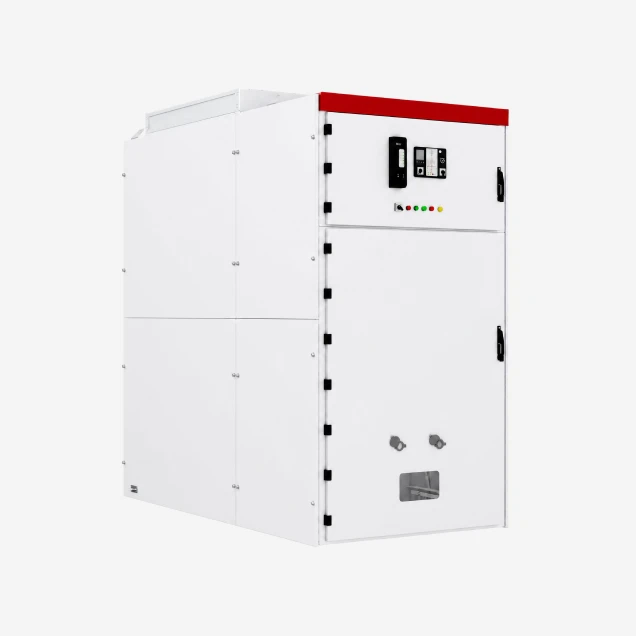
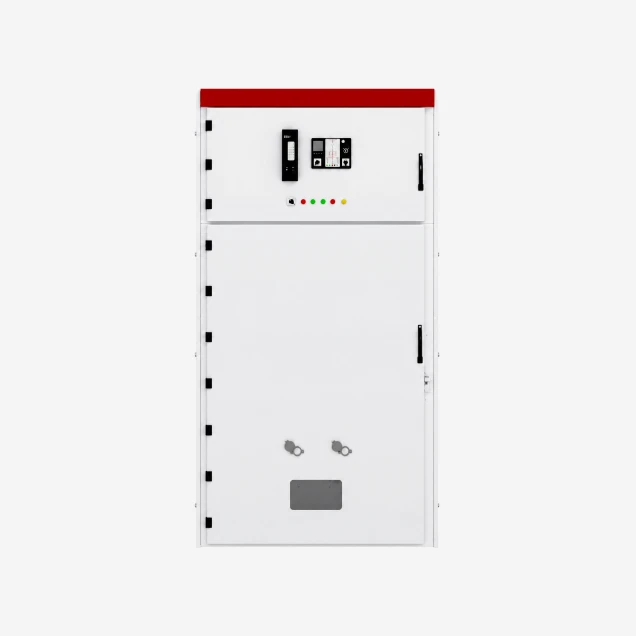
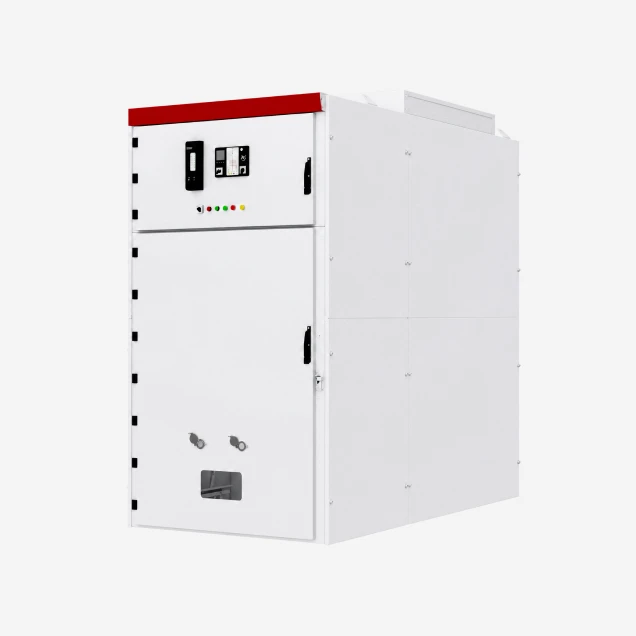
Armored Metal-Clad Enclosure for Fault Containment
The cabinet is built as an armored metal-clad structure that physically isolates the busbar, circuit breaker and cable compartments from each other. If a fault develops inside one compartment, the metal partitions contain the event to that compartment and stop it propagating to adjacent cells. This is the same containment principle that lets the panel carry its 31.5kA/1s internal arc fault rating, and it is why metal-clad construction is the accepted standard for 40.5kV primary distribution rather than metal-enclosed alternatives.
Complete Separation of HV and LV Compartments
The high-voltage compartments (busbar, breaker, cable) and the low-voltage control compartment are separated by grounded metal barriers with sealed cable transitions. Control wiring, protection relays and communication modules in the low-voltage compartment can be worked on with the panel energised on the HV side, which shortens commissioning time and eliminates a common source of operator exposure.
Modular Circuit Breaker with Selectable Interruption Technology
The breaker truck follows a modular design with a simple, high-endurance mechanical structure. You can specify a vacuum circuit breaker for standard duty, an SF6 circuit breaker where a smaller footprint or specific interruption characteristic is required, or other main-switch types matched to the project. A motorised vacuum breaker is available for remote or scheduled operation. Because the breaker mechanism and truck interface are standardised across the range, a future breaker upgrade or replacement is a same-day activity — no reworking of the panel structure.
Comprehensive Five-Prevention Interlocking with Closed-Door Operation
A complete mechanical and electrical five-prevention interlock is built into the breaker truck, earthing switch, cable compartment door and shutter mechanism. The operator cannot rack the breaker in or out with the primary contacts closed, cannot close the earthing switch onto a live circuit, and cannot open the cable compartment door until the circuit is isolated and earthed. Full closed-door operation is supported, so routine switching does not require the operator to open any high-voltage compartment.
Full Internal Arc Fault Resistance and AG3 Seismic Rating
The assembly is designed for full internal arc resistance and type-tested to a fault current of 31.5kA for 1 second. Pressure-relief flaps direct expanding gases upward, away from the operator zones at the front, rear and sides of the panel. Seismic performance reaches AG3, meeting the 8-degree earthquake intensity level under the Chinese national criteria — suitable for seismic-zone substations without additional structural bracing.
Internal Air Clearance ≥300mm and Composite Insulation for High Altitude
Internal air clearances between live parts meet or exceed 300mm — the reference distance in State Grid and China Southern Power Grid technical requirements at 40.5kV. For sites above the standard altitude range, a composite insulation configuration is available: solid insulation is applied at critical joints and busbar supports, extending the qualified design altitude to 3500m without oversizing the cabinet or derating the current rating.
Double-Sided Maintenance Access
The cabinet is dimensioned for double-sided maintenance. Cable connections, current transformers, earthing switches and the low-voltage compartment are all accessible from the rear or front as appropriate to the item. This gives the substation designer flexibility on switchgear room layout, and lets a service engineer reach any compartment without disturbing the adjacent panels in a line-up.
Digital Layer — Motorised Operation, Wireless Temperature and One-Key Sequential Control
The assembly is designed as a digital switchgear from the outset. Motorised vacuum breakers and motorised earthing switches allow remote or programmed operation. Wireless temperature sensors are fitted at incoming and outgoing terminals so joint temperature trends are collected without hard-wired thermocouple loops. Data feeds into a one-key sequential control routine, which executes the switching, earthing and isolation sequence with the correct interlocks in one operator action. This turns a multi-step routine (each of which can be mis-sequenced) into a single verified command from the substation SCADA.