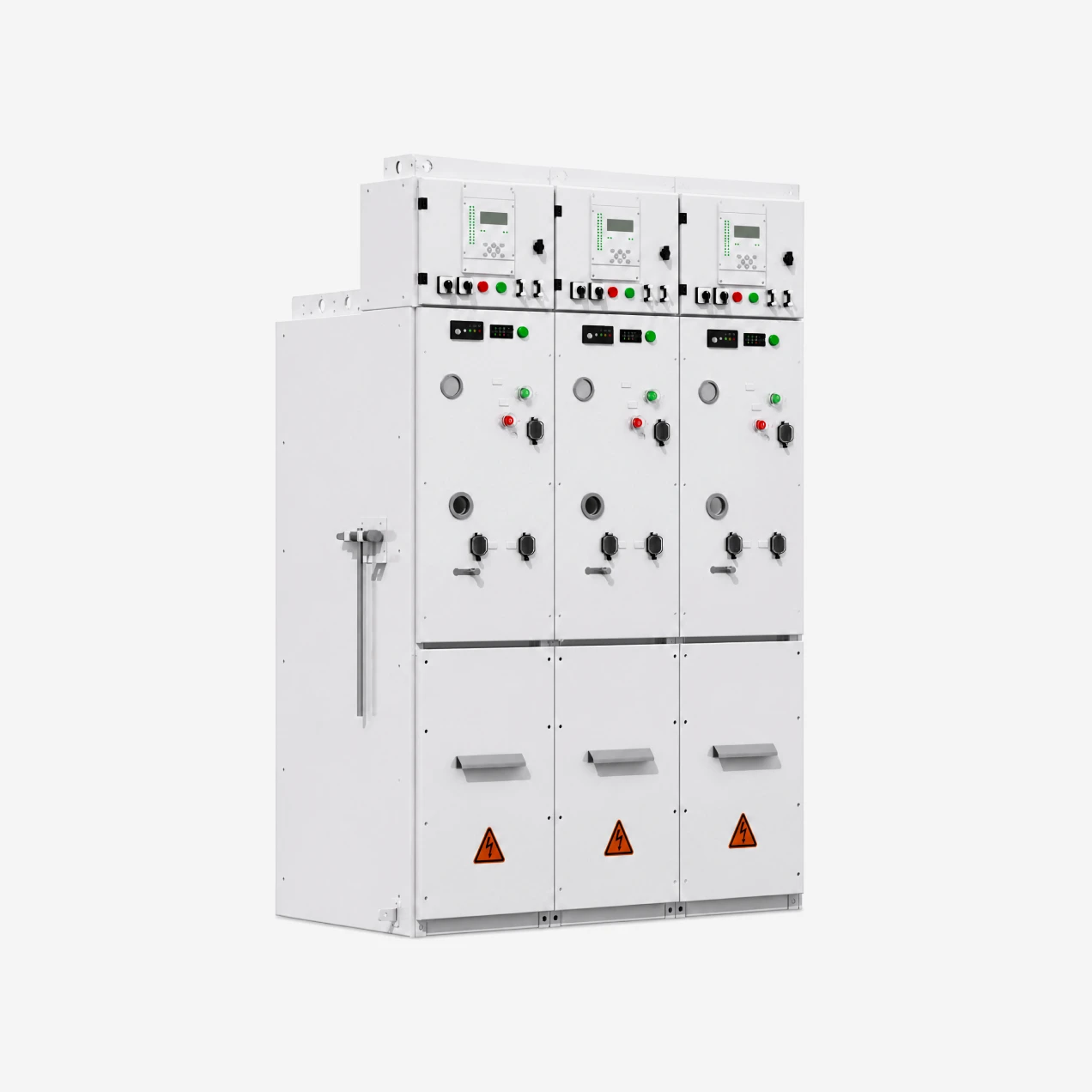
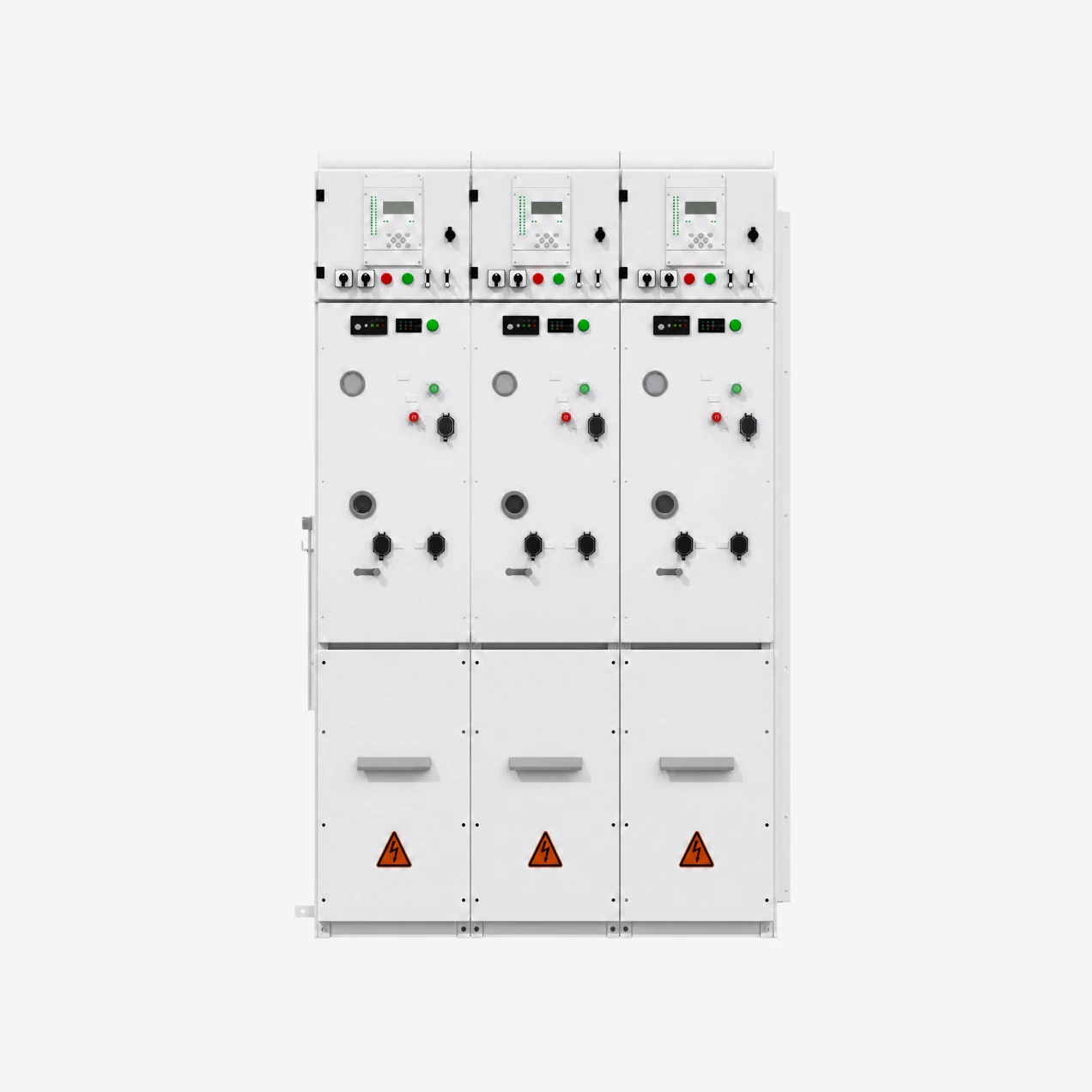
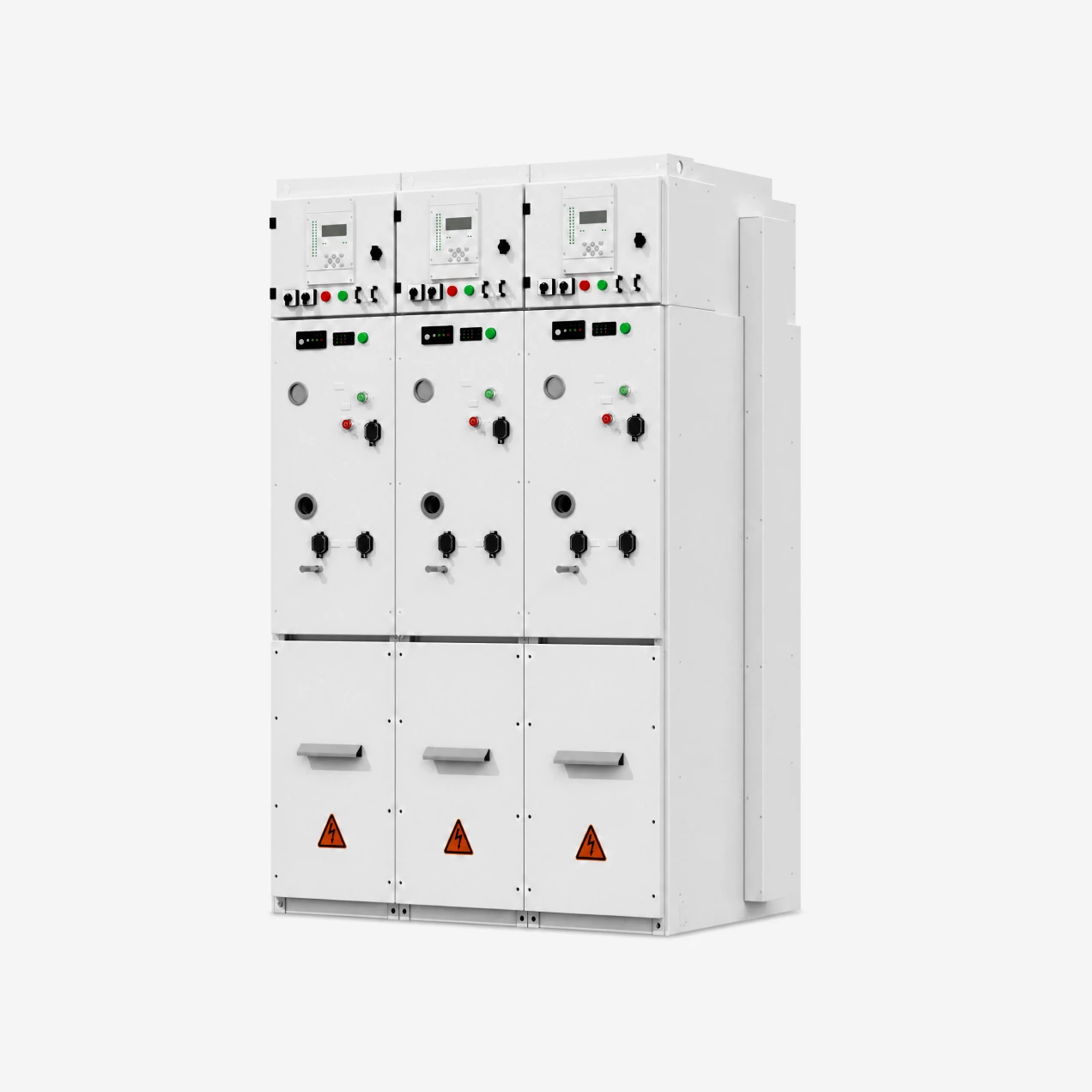
Nitrogen / Dry-Air Insulation — Zero-GWP Alternative to SF6
The switchgear uses nitrogen (or dry air) as the phase-to-phase, phase-to-earth and isolation-gap insulation medium. SF6 has a Global Warming Potential of about 23 500 times CO₂ and an atmospheric lifetime of roughly 3 200 years — the reasons behind the European Union's F-Gas Regulation phase-down for SF6 in medium voltage switchgear. Nitrogen and dry air have a GWP of essentially zero. From a lifecycle perspective — manufacture, service, end-of-life recovery and recycling — a nitrogen-insulated RMU eliminates the SF6 exposure entirely rather than reducing it. This is the platform we recommend for utilities and industrial operators subject to F-Gas Regulation, national grid green-renovation programmes, or corporate ESG scope-1 emission targets.
Vacuum Interruption for All Switching Functions
All three switching functions in the RMU — circuit breaker, load-break switch and earthing switch closing — use vacuum interruption. The traditional load-break switch plus fuse combination found in legacy 12kV RMUs is replaced by a vacuum breaker unit. This changes the fault-clearance behaviour meaningfully: the vacuum breaker trips at the initial stage of the fault, while a fuse-combination unit waits for the fuse element to reach breaking current and blow. Faster fault clearance means less thermal energy released into the cable network and less downstream equipment damage during a downstream fault event.
Sealed 3mm 304 Stainless Steel Tank with 0.3MPa Burst Pressure
The gas tank is built from 3mm 304 stainless steel plate and welded on 3D laser cutting and laser welding systems imported from TRUMPF (Germany). The tank is engineered to hold internal gas pressure at 0.3 MPa burst strength — the mechanical headroom that lets the tank contain the pressure spike from an internal arc event and safely direct the expanding gas to the dedicated pressure-relief pathway. Internal arc classification is AFLR 20kA / 0.5s, verified on the Front, Lateral and Rear sides.
99.99% Nitrogen Purity, ≤0.01% Annual Leakage, 40-Year Service Life
Every finished tank is leak-tested and gas-filled on a SEILER (Germany) automated helium leak detection and nitrogen filling line. Helium mass spectrometry verifies the ≤0.01% per year annual leakage rating factually rather than by extrapolation. The as-filled nitrogen purity reaches 99.99%, which is what keeps the dielectric performance predictable across the design service life. The rated design life is 40 years — 10 years longer than typical SF6 RMU installations — because the internal environment contains no reactive gas by-products, so the tank interior does not degrade in service.
Modular Single-Tank or Common-Tank Unit Combinations
Multiple unit combinations are available across the platform, from single-tank single-function units (one tank per functional unit) to common-tank multi-function units (multiple functions inside one tank). Extension busbars are fully-enclosed with an earthed conductive-paint outer coating, and can extend on the side, on the top or in mixed direction across a line-up. This lets the exact SLD-required feeder mix ship without cabinet volume compromise, and lets a future extension take a top-extension route when floor space is fully used.
10 000-Operation Vacuum Devices with Combined Earthing / Breaker Fault-Making
Vacuum circuit breakers and vacuum load-break switches are rated at 10 000 mechanical operations. Three-position isolator / earthing switches reach 3 000 mechanical operations. A specific feature: closing onto a short-circuit fault (fault-making current) is executed by an earthing switch + vacuum breaker combination, so the number of fault-making operations is not limited to the 2-operation cap that constrains conventional earthing switches. Operators managing feeders with a history of hard faults on close-in circuits get more operating headroom before the earthing switch reaches its service limit.
Full Digital Monitoring — Temperature, Gas Density, V/I, Five-Remote Ready
The platform is designed as a digital RMU: gas density in the tank, temperature rise at critical joints, current and voltage on each feeder are monitored in real time. Data feeds into a five-remote (telemetry, telesignalling, telecontrol, teleregulation, telecommunication) automation package, so the substation runs as an unmanned installation with attendance only for scheduled inspection or fault response. On grid green-renovation projects that replace 30-year-old SF6 or oil-insulated equipment, the digital layer also delivers the asset-monitoring baseline the utility needs to justify the investment.
Compliance and Applications: F-Gas, Grid Green Renovation, ESG
The platform targets three overlapping demand segments. First, projects governed by the EU F-Gas Regulation (Regulation (EU) 2024/573) that phases down SF6 in medium voltage switchgear — this RMU is a direct SF6-free replacement. Second, national grid green-renovation programmes that fund replacement of legacy oil or SF6 equipment with lower-emission alternatives — the platform qualifies as a green product for these programmes. Third, utility and industrial operators with corporate ESG commitments on scope-1 fluorinated gas emissions — replacing SF6 with nitrogen removes the emission at source. Solid-insulated RMUs are also within replacement scope: this platform delivers the sealed-tank environmental protection without the recyclability constraints of solid-insulation designs.